
The Debrief
Commonwealth’s Uncommon Stealth (Not Cricket)


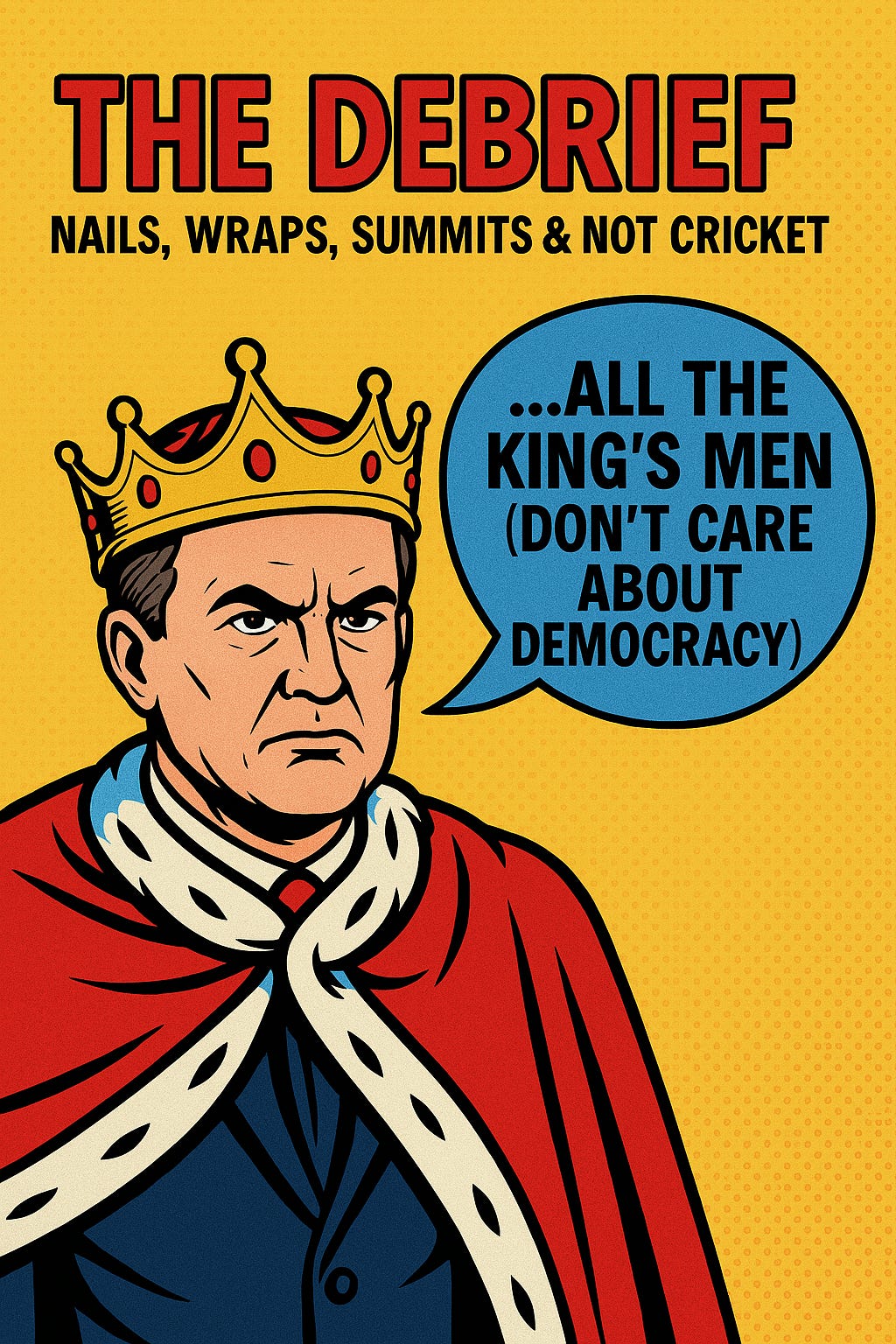
All the King’s Men (don’t care about democracy): The suppressed Commonwealth Observer Group (COG) report on Pakistan’s February 8 election has finally surfaced via Drop Site News. The findings are stark: from the outset, PTI was “consistently limited” in its ability to compete, thanks to lawfare and worse by the authorities.. The report cites communication blackouts, curbs on rallies, transparency gaps in counting, and most explosively, discrepancies between candidate-issued Form-45 results and official Form-47 tabulations — discrepancies that “may have resulted in some candidates being unlawfully returned.”
Obviously embarrassed, the Commonwealth Secretariat has now admitted the report exists and will be released “by the end of this month.” The Telegraph and other international outlets are already picking it up, marking the first time Pakistan’s post-election crisis has broken beyond the domestic echo chamber. PTI declaring that the 56-member organization, comprising mostly of former British colonies and founded upon the tradition of brotherhood and democracy, has helped the Pakistani military sustain its lies for over a year. The PTI is demanding an immediate and official release by the London office. Calls for Patricia Scotland, the Secretary General, are rising. But why was the report suppressed for so long? t,
Why it matters: Never before has a Commonwealth election report been withheld for such an extensive period. The existence of an unpublished EU observer report further compounds the impression of a legitimacy deficit that has now gone global. The battle over February 8, 2024 is no longer just opposition rhetoric; it is entering the bloodstream of international credibility.
Imran’s Gift Case seems to be falling flat: At Adiala Jail, the Toshakhana 2 case – premised on former PM Imran Khan allegedly selling state guests for personal profit - clocked a marathon 6.5-hour session — and concluded its latest phase. The highlight was the cross-examination of witnesses who stood against Khan, which by most accounts did not go in the state's favor. The proceedings left the prosecution on the back foot, with Khan’s attorneys claiming that the case had effectively fallen flat.
PTI, however, is positioning the case less as a courtroom drama and more as evidence of state persecution. The timing is critical: the Commonwealth leak gives PTI a fresh external validation of its narrative. By linking the bruising optics of Toshakhana to the broader charge of a rigged mandate, PTI hopes to turn legal defeats into political fuel.
Arab-Islamic Summit in Doha — sovereignty, deterrence, and the Qatar factor: The Gulf took center stage as Qatar convened Arab and OIC leaders at an emergency summit following Israel’s September 9 strike in Doha — the first targeted assassination in a U.S.-aligned Gulf capital. Emir Sheikh Tamim denounced the attack as “cowardly” and aimed at derailing mediation. Leaders pledged to activate joint defense mechanisms, reaffirmed Qatar’s role as mediator, and called for accountability.
The U.S. struck a careful balance: supporting Israel’s campaign against Hamas while signaling unease about the precedent of striking in Doha. Netanyahu, for his part, insisted Israel would pursue Hamas leaders “wherever they are.”
Pakistan angle: Islamabad is likely to double down on sovereignty and solidarity themes, presenting itself as aligned with Gulf outrage. Beyond diplomacy, Pakistan will also use the summit as a platform to court Arab investment and political cover at a moment of fiscal strain and international scrutiny.
Patriotism for sale —India’s championship bad cricket team: At the Asia Cup in Dubai, even a simple handshake became a flashpoint. After India’s win, its players refused to greet their Pakistani counterparts — an act that prompted a formal PCB protest to the Asian Cricket Council, criticism of “performative patriotism” , and global headlines in The New York Times and The Diplomat. When a basic courtesy turns radioactive, it shows how little space is left for even minimal civility between the two sides.
What made the gesture worse was the narrative tied to it. Much of the chest-thumping was framed around Pahalgam and “Operation Sindoor,” the military confrontation earlier this year. Yet India’s story doesn’t stand up to scrutiny. Pakistan has consistently denied involvement in the Pahalgam attack, even calling for a third-party investigation that India refused. On the battlefield itself, it was Pakistan that repelled Indian aircraft and forced a recalibration, while India’s standing abroad suffered. To now import that dispute into cricket — and justify refusing a handshake — looks less like pride and more like spin.
India’s cricketing posture toward Pakistan is less about principle than profit. Bilateral tours are frozen and diplomatic ties threadbare, yet when a major tourney comes around, India never walks away from the ratings, sponsorships, or broadcast deals that depend on Pakistan’s presence. Nothing sells like an India–Pakistan match — not even the Ashes. Nationalism is packaged, monetised, and sold back to the public.
Pakistan, meanwhile, does not need India to validate its cricketing pedigree. Its tradition, players, and trophies — from World Cups to Champions Trophy wins — stand on their own. If anything, it is India that relies on Pakistan to transform cricket into a global spectacle. That is why moments like the refused handshake only cheapen India’s own product, exposing how dependent Jay Shah and his BCCI are on gestures and theatrics to cover insecurities.
Why it matters: Cricket once functioned as a pressure valve in South Asia’s rivalry, with the cricket diplomacy in the Zia and Musharraf eras being proof that competition could coexist with respect. Now, with the BCCI being a franchise of the BJP and its right wing antics, it risks becoming just another theatre of managed hostility, where politics and profit overwhelm the spirit of play. The handshake that never happened is a warning: when sport is reduced to a stage for manufactured patriotism, it is not Pakistan that looks weaker — it is India.
Shiza’s Short Take: The past week laid bare how Pakistan’s crises are no longer confined to its borders: the leaked Commonwealth Observer Group report internationalized February 8 by exposing blackout tactics and Form-45/Form-47 manipulation, giving PTI’s stolen-mandate charge fresh global oxygen; in Doha, the Arab summit turned Israel’s strike into a sovereignty test, one Islamabad will leverage for Gulf solidarity and investment at a time of economic strain; and even on the cricket pitch, India’s refusal to shake hands showed how hollow performative patriotism looks when the BCCI still needs Pakistan to mint record ratings. Put together, the story is this: Pakistan may be battered, but the government’s legitimacy is bleeding abroad, PTI is converting setbacks into political capital, and India’s nationalism looks more like dependency than dominance.
Wajahat’s Long Take: For the first time in his life, Wajahat refused to watch a live India vs Pak game. In fact, he didn’t even bother with the highlights. He explains why in his vlog, here.
 | A guest post by
|