
The Debrief
Missiles, Monsoons, and Mask Trials


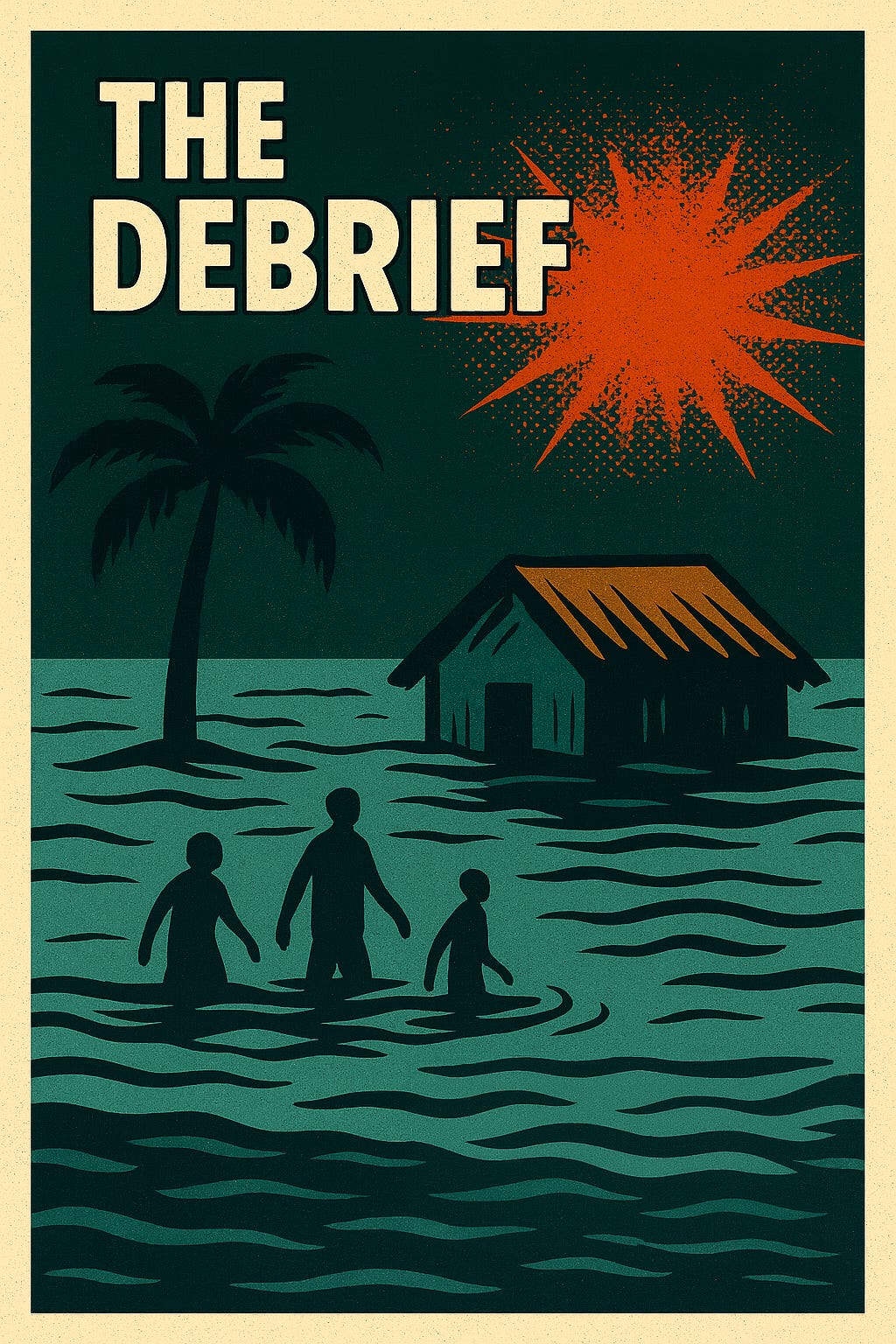
Punjab Submerged: AP reports nearly a million displaced as swollen rivers tore through Punjab. Reuters warns if Taunsa barrage collapses, two towns could vanish. Dawn’s live coverage painted villages cut off, camps overflowing, livestock drowned. Minister of Finance, Aurangzeb confessed Pakistan squandered its $11B aid pledges, while Gates’ $1m donation underscored how far reality falls from rhetoric. Meanwhile, Maryam Nawaz drew fire not just for her foreign trips but for theatrics at home — including a fake tweet from her own account claiming to be Wazirabad while it was elsewhere. For many, it sharpened the perception of a leadership more concerned with optics than with saving lives.
Courtroom Theater: While Punjab drowned, the spotlight shifted to Rawalpindi’s courts. Aleema Khan drew such a crowd outside the Anti-Terror Court that the media scrambled to cover it. Inside, her sons — Shehrshah and Shahrez, Imran Khan’s nephews — remained in custody on bizarre grounds: prosecutors boasted of having “recovered” a stick but insisted they still needed to find a mask and even their social media accounts — after 27 months. Salman Akram Raja scoffed: “Since when is a mask a crime?” These cases are less about justice than leverage — judicial spectacle aimed at pressuring Khan’s family and testing their resolve.
Boycotts with Exceptions: Imran Khan clarified PTI’s boycott: it applies only to constituencies where members were unjustly disqualified. But in Lahore, the late Mian Azhar’s seat will be contested — with Hammad Azhar pledging a family candidate. The party may be tactically retreating, but not everywhere.
Optics of Power: As Punjab drowned, the government’s image sank further. Critics pointed to Maryam Nawaz’s foreign tours, framing her as absent in crisis. Senator Aoun Abbas noted he had flagged the flood threat days earlier, only for officials to claim the waters “suddenly arrived.” Journalist Nadeem Malik added that waving at cameras was no substitute for real relief work. Sabir Shakir’s sneer — “Sainta ja sharmata ja, kaisay kaisay na-ahl nikamay musallat kiye hain” — distilled the anger: leaders posing abroad while villages vanished. At the same time, scandals around Ravi Homes and Park View City resurfaced. Nawaz Sharif’s presence at Ravi’s launch and Aleem Khan’s controversial housing empire became symbols of an elite building gated societies for themselves while ordinary Pakistanis watch their homes disappear under floodwaters.
Missile Race, China’s Shadow: Al Jazeera flagged a dangerous new chapter in the India–Pakistan rivalry: the missile race now runs through Beijing. India is expanding long-range precision systems not just for Pakistan, but to signal it can reach deep into China. Pakistan, in turn, leans more heavily on Beijing’s backing — military technology, diplomatic cover, and the comfort of a powerful ally — to balance against India’s edge. The contest is no longer a simple two-player duel; it’s about how each move reshapes China’s calculations in South Asia. The aftershocks of Operation Sindoor ripple well beyond the Line of Control.
Shiza’s Quick Take: Today is a story of misalignment. Missiles streak skyward while floodwaters rise below. In Punjab, villages drown as leaders fixate on courtroom masks and boycotts. Maryam Nawaz’s tours abroad and Aurangzeb’s hollow confessions sharpen the image of a state absent where it matters most. But the real storm is still ahead: as the waters push south, Sindh — Pakistan’s most neglected province — faces devastation with even thinner defenses. What Punjab struggles to survive, Sindh may not withstand. The irony is cruel: India’s missiles may unsettle China, but its dams unsettle Pakistan far more immediately. In this contest of priorities, survival — whether in Rawalpindi’s courts, Multan’s plains, or Sindh’s forgotten villages — remains the only currency.
Waj’s Long Take: In this vlog, here.
 | A guest post by
|