
Explainer: Pakistan’s Judiciary at the Tipping Point
Cracks in the Cathedral: Power, Rules, and the Fight for Legitimacy


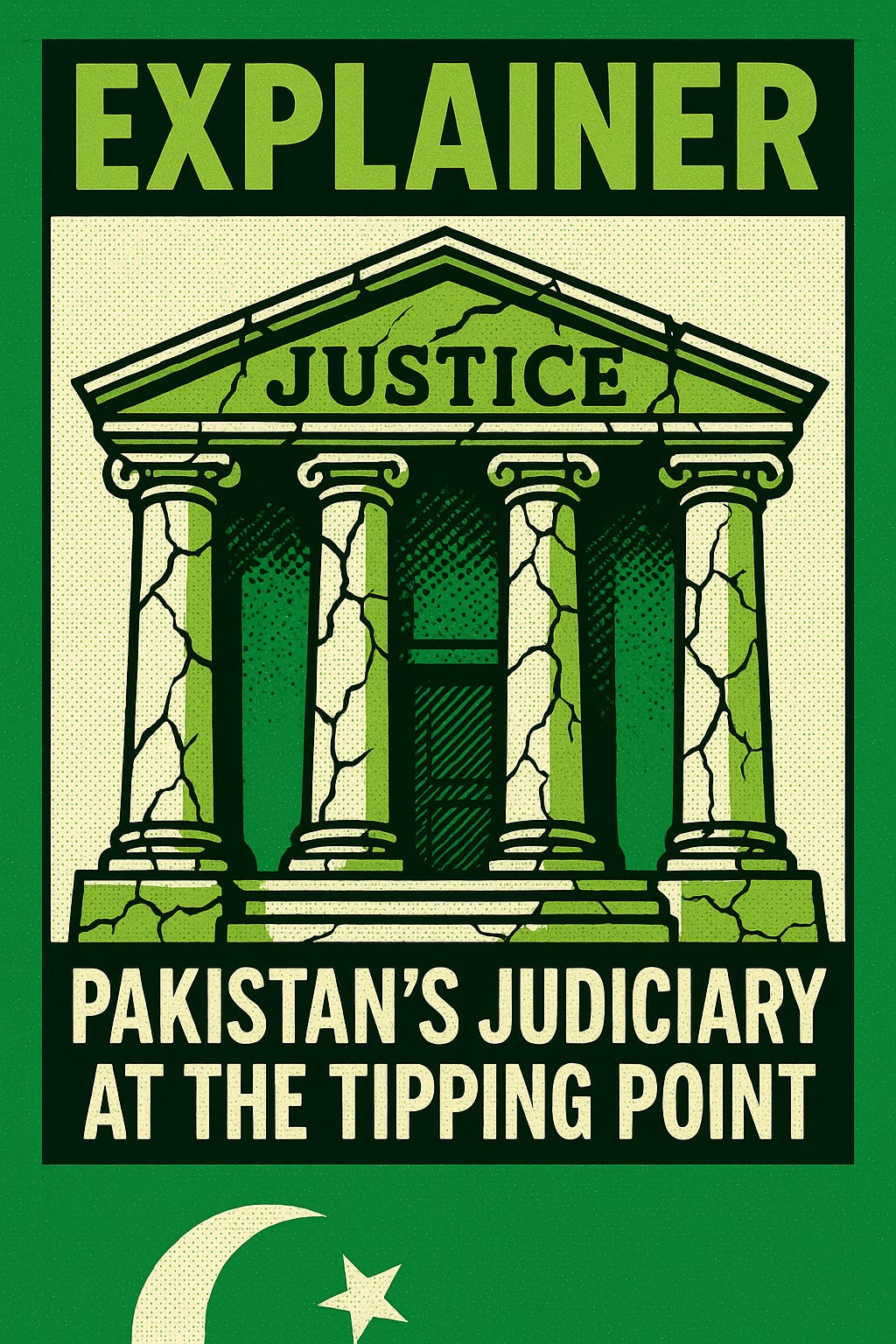
If justice is a nation’s last quiet cathedral, Pakistan’s judiciary resembles a building with cracked pillars and a door forever jammed. Allegations of interference, internal factionalism, and procedural sleight-of-hand have converged into a crisis of confidence. The fight is not only over cases; it’s over who sets the rules, who selects the referees, and whether the court belongs to the Constitution or to the currents that seek to bend it.
What follows blends the clarity of John Marshall’s constitutional craft with Justinian I’s institution-building instinct, tempered by Solon of Athens’ democratic fairness, King Solomon’s wisdom, and the humility of Caliph ʿUmar ibn al-Khattab—so the analysis stays moral and meticulous. We’ll keep it crisp and readable, but we won’t sand down the stakes.
How we got here: the hinge of power
Two structural moves define the present moment. First, the long arc of meddling—periodic military influence, political bargaining around benches and rosters, and a culture of “doctrine-of-necessity” contortions—left deep grooves in institutional behavior. Second, the 26th Constitutional Amendment (Oct 2024) rewired appointments at the very top: instead of simple seniority naming the Chief Justice, a parliamentary committee now chooses from among the three most senior judges. Supporters call this democratization; critics say it invites rule-by-deal inside the court itself. International rule-of-law groups warned the change could weaken judicial independence; the ICJ explicitly urged Pakistan to rethink the amendment, while major outlets documented how it reshaped the selection process that ushered Yahya Afridi into the Chief Justice’s office.
None of this lands in a vacuum. In March 2024, six Islamabad High Court (IHC) judges alleged pressure and surveillance by intelligence operatives—an extraordinary public airing that still shadows every debate about rosters and benches. Their letter made external interference a live institutional question, not a whispered complaint.
Why this week felt different
The past days compacted years of worry into a tight sequence:
Sept 4, 2025 — Athar Minallah’s broadside. At the Karachi Bar, Supreme Court Justice Athar Minallah said Pakistan’s judicial history is “not a source of pride,” and bluntly cast the so-called hybrid system as a dressed-up dictatorship. His remarks broke the polite silence that often mutes judges’ public speech.
Sept 4, 2025 — Babar Sattar’s warning. On the same day, Islamabad High Court Justice Babar Sattar deepened the drumbeat of dissent by flagging how opaque case assignments and bench formations had turned the IHC into what he called “administrative puppetry.” His charge echoed the 2024 letter signed by six IHC judges alleging interference and intimidation, but this time the focus was on internal mismanagement under the chief justice’s hand. By making his critique public, Sattar underscored that the judiciary’s ailments run through every tier, not just the Supreme Court.
Sept 5 — Mansoor Ali Shah’s six questions. Senior puisne judge Syed Mansoor Ali Shah wrote to CJP Afridi asking pointed, public-facing questions: Why were the Supreme Court Rules 2025 approved by circulation (administratively) rather than debated in full court? Why haven’t appeals challenging the 26th Amendment been fixed for hearing? What’s the policy on dissent, leave, and the committee meetings that are supposed to disperse power away from one man? Multiple outlets covered the letter’s substance and its implications.
Sept 8 — The full court showdown. A full-court meeting convened to “consider” the new Rules 2025. Four justices—Mansoor Ali Shah, Muneeb Akhtar, Ayesha Malik, and Athar Minallah—objected that meeting after approval-by-circulation risks turning the full court into a rubber stamp; they declined to attend and asked that their dissent be minuted. Coverage from Dawn and Express Tribune captured both the protest and the procedural core of the dispute. The same day, the court emphasized that the Rules would be treated as a “living document,” open to revision.
The reform pitch. In his new judicial-year address, CJP Afridi leaned hard into administrative reform: digitization of files and eventual AI-assisted case categorization—but he acknowledged “we’re not ready yet,” a useful humility that also underscores the gap between ambition and capacity.
Access for the diaspora. The Supreme Court created an Overseas Litigants Facilitation Cell (OLFC)—a WhatsApp/portal entry point for petitions, case updates, certified copies, and early-hearing requests for those abroad. It’s a practical nod to a globalized citizenry—and proof this crisis still has policy oxygen.
Taken together, the week’s story is simple: a senior judge indicts the court’s record; the senior puisne judge seeks answers on process; the CJP offers modernization without squarely meeting all the constitutional questions; four colleagues refuse to play seal-of-approval.
The fault lines—stated plainly
1) Who rules the rules? Article 191 vests the Supreme Court with the power to make rules. The fight is whether you can replace 1980 rules with 2025 rules by circulation—an internal administrative route—rather than open full-court debate before adoption. Four judges say circulation hollows the full court’s constitutional role; leadership argues the rules are revisable and now under review. This is a procedural question with constitutional bite: if procedure becomes a vehicle for control, independence decays even without a single noisy phone call.
2) Who picks the picker? The 26th Amendment broke seniority’s automatic conveyor belt. Advocates of the change will tell you Pakistan needs a broader, more accountable process. Detractors will reply that letting a political committee pick the court’s helmsman is an engraved invitation to factionalism—and that you see it already in rosters and reluctant calendaring of sensitive petitions (including challenges to that very amendment). International observers flagged the independence risk at passage; the constitutional questions remain unargued in open court.
3) Who controls the calendar? After the Practice & Procedure Act (2023), bench-making and suo motu allocation moved from the one-man model to a committee. On paper, that spreads power. In practice, critics say opaque rosters and selective listings still centralize control. When IHC judges describe “administrative puppetry” or publicly recount intimidation, even historically routine administrative choices look charged.
The numbers that haunt the courthouse
Pendency is not a statistic; it’s a moral category. Pakistan entered 2024 with 2.26 million cases pending across the system, according to official judicial statistics reported by Dawn and other outlets. More recent tallies still hover in the 2.2–2.3 million range, with the Supreme Court’s own backlog reported in the ~57,000 band this year. Any institution trying to speak credibly about justice has to stare those numbers down.
Afridi’s digitization push and the OLFC are not cosmetic—technology and access matter for a far-flung public—but they’re not substitutes for a case-management revolution and a due-process firewall around roster-making. The CJP’s “not ready yet” on AI is wise; the danger is premature automation hard-coding old biases.
The people and positions
Athar Minallah has become the court’s public conscience, insisting that the judiciary reckon with its role in legitimizing undemocratic episodes and in failing families searching for the disappeared. Naming the hybrid order a “dictatorship” is more than rhetoric; it’s a demand that the court look beyond docket-management to constitutional first principles.
Syed Mansoor Ali Shah is pressing institutional levers—minutes, meetings, records, criteria. His six questions aren’t gossip; they’re a governance checklist. Refusing to dignify a meeting he views as retroactive ratification is a risky bet—but it’s also an attempt to restore the full court’s deliberative authority.
Yahya Afridi, the CJP, is betting on managerial competence and incremental modernization. The reform slate—digitized files, e-services, SOPs, anti-graft helpline—is real. Yet the legitimacy deficit persists because the constitutional issues (who decides, how they decide, and whether the 26th Amendment’s core questions will be heard) remain unresolved in public view.
Outside the court, bar councils and the Supreme Court Bar Association have pressed hard on fees, transparency, and open Supreme Judicial Council hearings. Inside, the “rules-as-living-document” line signals that leadership is leaving itself a lane to adjust under pressure. That’s prudent—provided the revisions come with sunlight.
Why this matters—beyond Islamabad
Democracy’s circuit breaker. Courts are the system’s last neutral switch. When selection and roster control are perceived as political instruments, the switch fails. That invites exactly the politics the court exists to restrain.
Economics of unpredictability. Investors don’t flee ideology; they flee uncertainty. A docket that oscillates with political weather, or a bench that looks engineered for outcomes, translates into higher litigation risk and thinner investment pipelines. Pendency multiplies the cost of doing business; erratic listings raise it again. (Pakistan’s own judicial statistics and reporting make the pendency point in black and white.)
Social cohesion. When families of the disappeared believe no judge will hear them unless politics permits it, the Constitution becomes a rumor. That corrodes civic trust faster than any deficit or devaluation.
Geopolitics and credibility. A court suspected of executive capture cannot credibly referee election disputes or rights crises. International rule-of-law warnings about the amendment weren’t performative—they were early hazard lights on the dashboard.
What a Solon-worthy course correction would look like
1) Put the Rules back in the room. Publish the drafting history and circulate proposed revisions; convene a transparent, minuted full-court sitting dedicated to the Supreme Court Rules 2025—streamed, if feasible. Require reasoned votes on contested provisions (fees, listings, committee powers). The “living document” promise is credible only if the public can watch it breathe.
2) Hear the constitutional case about the 26th Amendment. Calendar the petitions; set a robust, senior-heavy constitutional bench; invite focused amici from across the legal academy (Sunstein-style institutional analysis, Amar-like constitutional structure, Dworkin’s rights-as-principle lens) and from Pakistan’s comparative traditions. A reasoned judgment—whichever way it lands—beats governing by delay.
3) Codify “roster due process.” Publish neutral assignment criteria; rotate sensitive matters across senior benches; minute dissent on bench-formation; and adopt a uniform right to be heard timeline for urgent fundamental-rights cases. The 2023 Practice & Procedure framework was supposed to dilute one-man power; implement it with verifiable process.
4) Attack pendency where it lives. Adopt a case-ageing protocol (oldest cases first), set time limits for judgment issuance in routine matters, and expand mediation/ADR for commercial disputes. Deploy tech, yes—but measure what matters: listing-to-disposal times by category, judge-wise and bench-wise, published quarterly.
5) Protect the courthouse from the phone call. Operationalize an interference-reporting mechanism flowing into the Supreme Judicial Council with mandatory public summaries. The IHC judges’ 2024 letter should never have been the first line of defense. Build a firewall, then show it works.
6) Keep the door open to the world. Institutionalize the OLFC with SLAs (response times, e-copy issuance windows), and publish monthly performance dashboards. For a diaspora that wires money home but can’t get a hearing date, this is dignity in administrative form.
The bottom line
Pakistan’s judiciary is arguing with itself about something deeper than fees or file-scanners. It’s deciding, in public and in real time, whether its procedures still secure its principles. If the court treats rules as instruments of control rather than guarantees of fairness, no digitization plan can save its legitimacy. If, instead, it subjects its own power to transparent process, hears the constitutional challenges it has avoided, and locks in roster due process, it can still rebuild authority—quietly, case by case.
Solomon would insist the sword stay sheathed until both sides have been truly heard. ʿUmar would ask who the rules burden most. Justinian would codify the fix. Marshall would write an opinion that survives a century. And Solon would make sure the poorest litigant can read it, understand it, and believe it was written for them.
Right now, Pakistan’s highest court doesn’t need a savior. It needs a schedule, a spotlight, and the courage to be governed by its own Constitution. The week’s drama—Minallah’s indictment, Shah’s questions, the four-judge protest, the CJP’s reform pitch, the OLFC—has cleared the fog. The next moves will tell the country whether the Supreme Court intends to be an institution again, not a stage.
 | A guest post by
|